
THE BRIDGE THAT LOVE BUILT: God's Divine Connection to Humanity - BIBLE STUDY WORKBOOK
The Bridge that Love Built Workbook Blog Video
You Have Been Trying to Build What Only God Can Build: Six Formation Truths from The Bridge That Love Built Intensive Bible Study Workbook
A 7-minute read
There is a particular kind of exhaustion that has nothing to do with how much sleep you got last night.
It is the exhaustion of striving - of reaching toward God through effort, performance, and moral self-improvement, and finding that no matter how high you stack the bricks, the other side never gets any closer. If you have felt it, you already know the terrain this workbook is designed to map.
The Bridge That Love Built: Intensive Bible Study Workbook - companion to Chibueze Ukaegbu's book of the same name - is an eleven-chapter formation tool built around one theological spine: God did not leave humanity stranded on the far side of separation. He built the only Bridge strong enough to span sin, sorrow, rebellion, and death - and His name is Jesus Christ.
Each chapter contains a Scripture anchor, a theological big idea, section-by-section reflection questions moving through Observe → Interpret → Apply, lined journaling space, a self-assessment table, a practical decision-making framework, a seven-day application challenge, and a prayer prompt with memory verse. These are not decorations around a reading guide. They are the architecture of a formation process designed to move truth from the head into the places where you actually live.
Here are six of the most penetrating truths the workbook draws out of the journey.
1. Your Longing Is Not a Problem to Solve - It Is a Diagnosis to Receive
Chapter 1 opens with a theological big idea that reframes something most people spend enormous energy trying to escape: "Separation from God is not the final word - it is the opening diagnosis that makes the gospel necessary. The ache of longing is not a sign of abandonment; it is the soul's memory of a closeness it was created to know."
The emptiness you feel is not a malfunction. The restlessness that surfaces in quiet moments is not weakness. It is the soul accurately reporting its condition. The self-assessment asks whether you sit with spiritual longing honestly rather than numbing it with distractions, and whether you believe that your longing for God is itself evidence of His work in you.
The Day 1 challenge asks you to sit in ten minutes of silence and write what actually surfaces. Most of us have not sat quietly long enough in years to hear the real answer to the question the workbook is asking: What is your soul actually thirsty for?
2. Sin Is Not a List of Behaviors - It Is a Severed Thread
Chapter 2 refuses the common reduction of sin to a catalog of infractions. Its theological big idea cuts deeper: "Sin is not a surface problem requiring surface solutions - it is a fundamental rebellion of the human heart that severs the life-giving thread between Creator and creation. Until the depth of this rupture is honestly faced, the Bridge remains theoretical."
The workbook identifies three distinct layers of fracture that sin produces: with God, with others, and with the self. The reflection questions press on each one by name. One question asks which fracture you feel most acutely in your current life. Another names the Pharisees of Matthew 23 as a case study in how religious effort without genuine relationship becomes its own form of bridge-building dressed in the language of devotion.
The decision framework does not move toward behavior modification. It moves toward something harder: "What self-constructed bridge - good works, religion, denial - have I been relying on instead of grace?" The framework closes by prompting a specific, honest confession for each layer of fracture - not a general prayer of repentance, but named acknowledgment of exactly what has been torn. This is formation work. It assumes that naming precedes healing.
3. Every Bridge You Have Built Is Already Cracking
Chapter 3 - DIY Bridges: Human Attempts and Failures - is the workbook at its most diagnostic. The big idea: "Every human-built bridge - morality, religion, philosophy, self-improvement - is a sincere but ultimately insufficient response to a gap that only God can span. Recognizing the fragility of our own constructions is not defeat; it is the first step toward the only Bridge that holds."
The self-assessment asks: I recognize when I use good works as a substitute for trust rather than as a response to it. That distinction - trust versus trust's response - is the axis on which the entire chapter turns. The Day 5 challenge asks the reader to spend fifteen minutes simply receiving rather than striving - present before God with nothing in their hands.
The framework step that lands hardest is Step 3: "Expose its failure points - where and when has this bridge swayed or cracked under pressure?" Most people can identify a self-constructed bridge if pressed. Fewer have sat with the specific moment it gave way. The workbook insists on that moment, because it is precisely there that the heart is most open to something it did not build.
4. God Was Not Reacting to Your Failure - He Was Already Building
The theological pivot arrives in Chapter 4. The big idea: "God did not respond to the chasm with distance or demand - He responded with design. Before creation, Love was already drawing blueprints. The divine initiative is not a reaction to our failure; it is a revelation of God's eternal character."
This means the Bridge was not an emergency response. The sacrificial system, the Tabernacle, the Temple - all shadows, as Hebrews 10:1 says, pointing forward to a design that was always the plan. The Day 2 application challenge asks the reader to choose one Old Testament sacrifice or feast and trace how it points to Christ - what the workbook calls shadow hunting. It reveals that the love you are only now receiving was being prepared for you long before you arrived.
The self-assessment's most probing trait: I allow suffering and uncertainty to deepen my trust in the Architect rather than eroding it. For anyone who has questioned God's goodness in a hard season, this is the chapter that gives that question somewhere to land.
5. The Cross Is Not Familiar - It Is Final
Chapter 6 carries a theological big idea built for precision: "The cross is not God's failure - it is His finest work. It is the precise point where infinite justice and unstoppable love collide and, impossibly, both win. The chasm is not negotiated at the cross; it is annihilated by substitution."
The self-assessment here exposes one of the most common problems in mature Christian life - not unbelief in the cross, but familiarity with it. One trait reads: I take the cross seriously rather than treating it as familiar or routine. Another: The cross produces both awe and rest in me simultaneously. These are diagnostic instruments for people who have believed for years and need to ask whether that belief is still alive.
The decision framework includes one of the most personally searching steps in the entire workbook: "Write one sentence beginning with 'Because of the cross, I no longer need to...' and complete it honestly." How you complete that sentence will reveal exactly what you have not yet received.
6. Faith Is Not the Feeling of Certainty - It Is the Decision to Cross
Chapter 8 on faith refuses to romanticize what it is asking. The theological big idea: "The Bridge exists, but it must be crossed. Faith is not the construction of the Bridge - it is the decision to step onto it. It requires releasing the firm ground of self-reliance and trusting that what God has built will hold every ounce of your weight."
The framework presses for specifics: Step 1 asks where you are currently standing at the edge, hesitating. Step 2 asks for the name of the fear - not in general but precisely. Step 5 asks for the action and the date.
The Day 4 challenge draws the contrast that holds the chapter together: identify one area where you are walking by sight - waiting for evidence - rather than walking by faith - trusting God's Word. Most people find they have been doing far more of the former than they had admitted.
What the Workbook Is Really Doing
Across all eleven chapters - from the diagnosis of separation through sin's rebellion and humanity's failed bridges, through the incarnation, cross, and resurrection, into the daily practice of faith, transformation, and eternal connection - this workbook is doing one thing: closing the distance between what you believe in your head and what is actually true in your life.
The commitment page at the close of the epilogue asks for five specific declarations: one truth to anchor your life to, one change in how you understand God, one sin or self-made bridge you are leaving behind, one person you will tell about the Bridge, and one daily practice you are committing to. It is signed and dated.
That signature matters - not because it makes anything legally binding, but because the workbook has insisted from page one that formation happens in named moments, honest confessions, and daily choices made by actual people in actual circumstances.
The Bridge that Love built spans the full distance. The only question the workbook ever really asks is the one posed in the epilogue:
Will you cross?
The Bridge That Love Built: Intensive Bible Study Workbook by Chibueze Ukaegbu is designed for individual study or small groups and pairs chapter-by-chapter with the companion book. Available on Amazon.*
This post references:
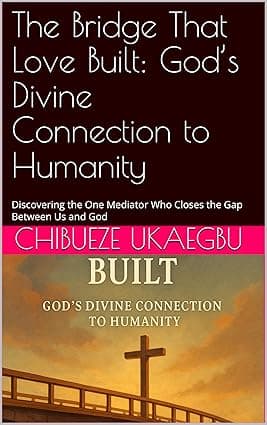
The Bridge That Love Built: God’s Divine Connection to Humanity
Discovering the One Mediator Who Closes the Gap Between Us and God
View Book →Comments (0)
No comments yet. Be the first to share your thoughts!